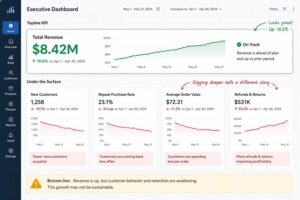

You’re running Google Ads, collecting leads in Jotform, and managing donors in HubSpot. So why does your board still get a spreadsheet assembled on a Friday afternoon?
“What’s our cost-per-donor this quarter?”
If answering that question requires two hours, three exports, and a pivot table — your organization has hit the Data Ceiling. And you’re far from alone.
For nonprofits with 10 to 100 staff, there’s a predictable inflection point. You’ve invested in the right tools — Google Ads grants, a HubSpot CRM, Jotform for intake — but the data living inside those tools is siloed, stale, and inconsistently formatted. The result? Your leadership can’t make confident, real-time decisions because no one has built the pipes to connect everything.
This post breaks down exactly how mid-sized nonprofit teams can implement a nonprofit data strategy that eliminates the manual scramble and replaces it with automated, board-ready reporting — without hiring a full-time analyst.
The “Data Ceiling”: What It Is and Why It Happens
The Data Ceiling isn’t a technology problem. It’s an architecture problem. Most nonprofits in the 10–100 staff range have accumulated a stack of point tools that each do their job reasonably well:
- Google Ads — driving awareness and donor acquisition campaigns
- Jotform — collecting volunteer signups, event RSVPs, and intake forms
- HubSpot CRM — managing donor and constituent records
- QuickBooks or spreadsheets — tracking financials and grants
- Eventbrite or SimpleTix — ticketing and event attendance
The problem is that none of these tools talk to each other automatically. Every week, someone manually exports a CSV from Google Ads, pastes it into a spreadsheet, cross-references it against HubSpot contact records, and tries to reconcile duplicates. By the time the data is clean enough to use, it’s already three days old.
For a growing nonprofit, this is more than an inconvenience. It’s a strategic liability. You can’t optimize your Google Ads ROI for charities if you don’t know which campaigns are converting to actual donors — not just clicks. And you can’t make the case to your board for increased ad spend without clean, integrated numbers.
Why HubSpot for Nonprofits Is More Powerful Than Most Teams Realize
HubSpot for nonprofits is one of the most underutilized platforms in the sector. Most organizations use it as a glorified contact list. But with proper configuration, HubSpot becomes the central hub of your entire donor intelligence operation.
Here’s what a properly integrated HubSpot environment looks like for a mid-sized nonprofit:
The key is connecting the data at the source. When a prospective donor clicks a Google Ad, fills out a Jotform intake form, and gets added to HubSpot — that entire journey needs to be tracked with consistent UTM parameters, field mappings, and deduplication logic. Without that foundation, you’re measuring activity, not outcomes.
The 5,000-Record Problem
In our experience auditing nonprofit CRMs, the average organization with 5,000+ HubSpot contacts has significant data quality issues: duplicate records, inconsistent naming conventions, missing lifecycle stages, and contacts who haven’t been touched in years. Dirty data doesn’t just waste storage — it actively corrupts your reporting. Your cost-per-donor calculation is only as accurate as the records behind it.
A proper nonprofit data strategy begins with a full CRM audit and cleanup before any new integrations are built. You can’t automate chaos.
Measuring Google Ads ROI for Charities: The Right Way
Google’s Ad Grants program gives eligible nonprofits up to $10,000/month in free search advertising. That’s a significant resource — but only if you can measure what’s actually working.
Most nonprofits track vanity metrics: impressions, clicks, website sessions. What they should be tracking is the full attribution chain:
- Ad click → Jotform submission → HubSpot contact created → Donor conversion
- Cost-per-click → Cost-per-lead → Cost-per-donor (the metric your board actually wants)
- Campaign → Ad group → Keyword → specific donor segment performance
When these connections are built correctly, you can answer questions like: “Which Google Ads campaign produced our highest-value recurring donors last quarter?” — in seconds, not hours. That’s when data stops being a reporting burden and starts being a competitive advantage.
The Old Way vs. The Rila Way
There are two paths to solving the Data Ceiling. One is the traditional approach. The other is what we’ve built specifically for growing nonprofits.
Full-Time Data Analyst Hire
$90k+/yr
- 3–6 month ramp-up time
- Benefits, overhead, management cost
- Single point of failure
- No strategic BI experience
- Vacancy risk when they leave
Fractional Data Team (The Rila Way)
$2,500/mo
- Onboarded in days, not months
- Technical setup + weekly alerts
- CRM audit + 5k record cleanup
- Board-ready dashboards included
- Scales with your organization
The fractional data analyst model was designed for exactly this situation. You don’t need a full-time analyst sitting in your office — you need someone who has already solved this problem dozens of times for organizations like yours and can implement the solution without a learning curve.
For $2,500/month, you get the technical infrastructure (HubSpot integrations, Google Ads attribution, Jotform pipeline), the ongoing data stewardship (weekly anomaly alerts, monthly board reports), and the strategic layer (what the data means and what to do about it). It’s the full stack of capabilities you’d hire three different people to cover, delivered as a single managed service.
What a Nonprofit Data Audit Actually Covers
Before any integration work begins, every Rila Group engagement starts with a structured data audit. Here’s what that includes:
HubSpot contact database review — duplicate detection, field mapping, lifecycle stage accuracy
Google Ads account structure — campaign naming, conversion tracking, UTM consistency
Jotform → HubSpot field mapping — are form submissions creating the right contact properties?
Reporting gap analysis — what questions can’t you answer today that you should be able to?
Data governance recommendations — who owns each system and how should updates be managed?
The audit output is a prioritized roadmap that tells you exactly what needs to be fixed, in what order, and what the outcome will be. No generic recommendations just a specific plan for your organization’s actual stack.