
Rila Group · Business intelligence · Strategy
Why your business needs a referee, not just more players
In a crowded market of agencies and specialists all selling "more," the executives who scale with confidence aren't the ones who hired the best players. They're the ones who finally got an unbiased scorekeeper.
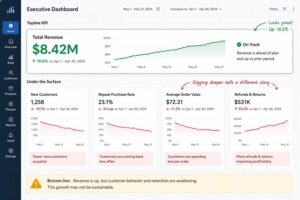
As a CEO or founder scaling an e-commerce or digital-first business, you've likely noticed a frustrating pattern: your marketing reports paint a picture of growth while your bottom line tells a different story. ROAS is up. CAC is "manageable." Your agency just sent a deck with record-breaking numbers. And yet, the bank account isn't moving the way it should.
The instinct is to hire more specialists. Another media buyer. A better creative agency. A platform expert for TikTok. More players on the field.
At Rila Group, we've seen this cycle across dozens of engagements, and the conclusion is consistent: the problem isn't your marketing. It's your measurement. And no amount of execution-side talent fixes a broken measurement layer.
"The executives who scale with confidence aren't the ones who hired the best players. They're the ones who finally got an unbiased scorekeeper."
The measurement problem no one talks about
Every platform you spend money on Meta, Google, Amazon, TikTok has a reporting engine built to justify its own existence. Attribution windows are set generously. View-through conversions inflate numbers. Last-click models obscure what actually drove the sale. This isn't malicious; it's structural. Platforms are incentivized to look indispensable, and their reporting reflects that.
Agencies face the same conflict. A media buyer's value is measured by the numbers in their reports. A 6.0 ROAS sounds compelling but what does it actually cost to generate that revenue when you factor in overhead, fulfillment, returns, and the margins you're protecting? Most agency reports never ask that question.
The result is a business operating on optimism rather than intelligence. Leaders make budget decisions based on reports that were designed to look favorable, not to reveal the truth. Capital flows toward the channels that report best not the channels that perform best.
What a dedicated BI partner actually does
Rila Group is not a marketing agency. We do not manage ad spend, produce creative, or run campaigns. What we do is sit one layer above all of that — aggregating, normalizing, and analyzing the data your entire marketing and operations stack produces, independent of any platform or agency relationship.
Think of the distinction this way: agencies are the players. Rila Group is the referee. The players execute. The referee ensures the game is being scored correctly.
Key distinction
An agency's success metric is platform performance. Rila Group's success metric is EBITDA. These are fundamentally different orientations and only one of them aligns with your actual business goals.
This independence is the core of our value. We don't have a platform to protect, a retainer to justify through vanity metrics, or an incentive to make any particular channel look successful. We want the math to be right. That's it.
Four pillars of independent analytics
Our framework is built around four interconnected capabilities, each designed to address a specific gap in how most businesses currently use data.
Statistical modeling over platform reporting
We aggregate your historical sales data alongside external market variables — seasonality, category trends, macroeconomic signals and apply time-series analysis across your full data stack. The result is a forecast built on what actually happened, not what any single platform wants to take credit for. We provide the forecast. Your team uses it to set budgets and allocate spend. The model is neutral because it has to be.
Data neutrality as a structural advantage
Independent data verification means every dollar of reported performance gets tested against your actual revenue and profit. We use this to hold agencies and platforms accountable not with confrontation, but with facts. When your agency's ROAS and your P&L tell different stories, we give you the evidence to ask the right questions and make the right adjustments.
Data engineering and ETL infrastructure
Most growing businesses are sitting on a goldmine of data trapped in silos. Shopify orders, Google Ads spend, Meta impressions, Amazon fulfillment each living in its own dashboard, requiring manual reconciliation to see the full picture. We build automated ETL pipelines that extract, normalize, and unify your data into a single live schema, eliminating the 10+ hours per week your team currently spends in spreadsheets and replacing it with a real-time KPI dashboard that updates without human intervention.
Business intelligence for capital allocation
The question we hear most often is: "If you don't run my ads, what do I actually do with this data?" The answer is that you use it to lead. Our dashboards surface Revenue Attribution, LTV:CAC ratios, and channel-level profitability not to replace your agency's work, but to give you the intelligence layer that tells you whether their execution is producing the outcomes your business actually needs. You decide where to scale, where to cut, and where to test.
What this looks like in practice
A client comes to us with a common situation: two agencies, three advertising platforms, a Shopify store, and a growing suspicion that their blended ROAS isn't telling the whole story. Their team is spending the better part of Monday mornings pulling reports and copying numbers into a master spreadsheet a process that is both time-intensive and inherently error-prone.
Within the first engagement phase, we build a unified data pipeline that connects every source into a single normalized model. For the first time, leadership can see actual attributed revenue by channel, margin by product category, and LTV trends by acquisition cohort all updated daily without manual effort.
What typically emerges: one or two channels are dramatically outperforming their reported ROAS in real profitability terms. One or two others are doing the inverse. The allocation shifts accordingly not based on anyone's opinion or any agency's reporting, but based on the data.
"For the first time, leadership could see actual attributed revenue by channel, margin by product category, and LTV trends by acquisition cohort — all updated daily, without manual effort."
The case for an unbiased data layer
The businesses that scale most effectively aren't necessarily the ones with the best agencies. They're the ones with the clearest picture of what's working. That clarity is difficult to achieve when every data source you're relying on has an inherent reason to make itself look good.
An independent analytics partner doesn't replace your agencies or your platforms. It creates accountability for all of them including you. When you have a neutral source of truth, every conversation about performance becomes more productive, every budget decision becomes more defensible, and every scaling move becomes less of a gamble.
That's what Rila Group provides: not more execution, but the intelligence infrastructure that makes all of your execution smarter.
Get started
Ready to see the truth in your data?
Schedule a free discovery call. We'll map out exactly what an independent analytics layer would reveal about your business and where the real growth is hiding.
Book a discovery call