When the Measure
Becomes the Target
Goodhart's Law explains why your KPIs can look perfect while your business quietly drifts off course — and what Rila Group does about it.
Every organization that has ever built a dashboard has, at some point, optimized its way into a lie. Not intentionally. Not maliciously. But the moment a KPI becomes the thing people are rewarded for hitting, it stops measuring reality and starts measuring the ability to game a number. That is Goodhart's Law, and it is quietly undermining analytics programs across every industry.
The Law That Should Be Taught in Every Business School
Charles Goodhart was an economist at the Bank of England in the 1970s when he articulated what would become one of the most quietly devastating observations in management science. He was talking about monetary policy specifically, how using any statistical measure as a control target would ultimately destroy its usefulness as an indicator. But his observation turned out to apply far beyond central banking.
It applies to call centers that hit their average handle time targets by rushing customers off the phone. It applies to schools that achieve impressive test scores by narrowing their curriculum to the test. It applies to sales teams that crush their call volume quotas by making low-quality contacts that never convert. And it absolutely applies to every business that has ever set a KPI, put it on a dashboard, and assumed the number was telling the whole truth.
KPIs are proxies. They are never the thing itself they are our best attempt to quantify something we actually care about. The moment we treat the proxy as the destination, we stop caring about the destination and start caring about the proxy. The map becomes the territor. The metric becomes the mission.
Real-World Goodhart Failures: Familiar Numbers, Wrong Answers
These patterns show up constantly across the industries Rila Group serves. The specific numbers change. The underlying trap does not.
Why Goodhart's Law Is an Analytics Problem, Not Just a Management One
Most discussions of Goodhart's Law frame it as a leadership or incentives problem people game metrics because they are rewarded for hitting them. That is true, but incomplete. The deeper issue is that it is also a data design problem.
When an analytics team builds a dashboard and hands it to an organization, that team is making a series of consequential decisions: which metrics to surface, how to define them, what timeframes to use, what to leave out. Each of those decisions shapes what the organization pays attention to. Build a dashboard that shows website sessions without conversion quality, and the team optimizes for traffic. Show revenue without margin, and they optimize for top-line growth. Show engagement without retention, and they optimize for acquisition.
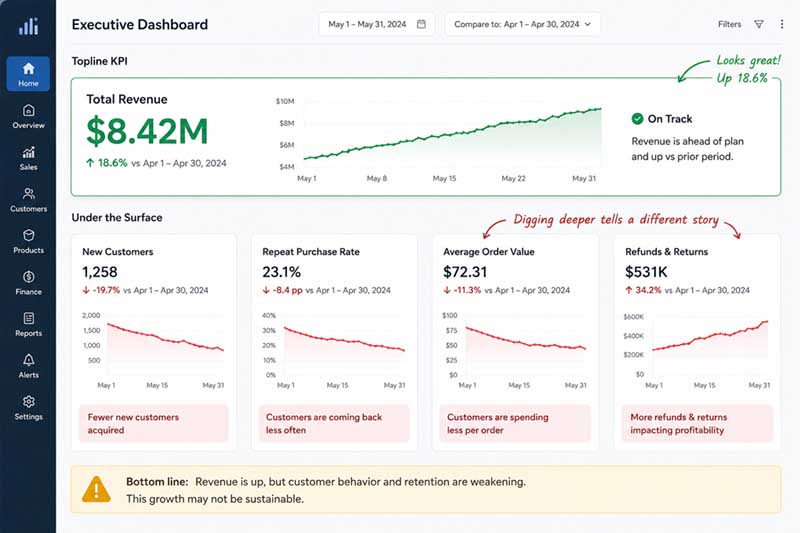
The most dangerous dashboard is one that makes everything look fine — because it was designed to show only the things that could look fine.
Goodhart's Law does not require bad intentions. It requires only that a metric become important enough to manage toward and any metric worth putting on a dashboard is, by definition, important enough to manage toward. The trap is structural. The solution has to be structural too.
How Rila Group Approaches KPIs Differently
At Rila Group, we do not deliver KPIs and walk away. We treat every metric as a hypothesis about what drives value in a specific organization and we build the surrounding context that lets leaders distinguish between numbers that are improving and outcomes that are improving. Those are not always the same thing.
Our approach is structured around a discipline we call KPI integrity a set of practices that keep metrics honest as organizations evolve and as the pressure to hit targets increases.
The Five Practices That Keep KPIs Honest
Pair every primary metric with a counter-metric
If you measure speed, also measure quality. If you measure volume, also measure value. Counter-metrics create natural tension that makes optimization in one direction at the expense of the other immediately visible. For a nonprofit measuring donor count, the counter-metric is average gift size and five-year retention rate. For an e-commerce business measuring ROAS, the counter metric is contribution margin per order.
Define the behavior each KPI incentivizes before you deploy it
Before any metric goes on a dashboard, we ask: if a team member's performance were evaluated on this number, what would they do? What would they stop doing? Sometimes the answer reveals that the metric as defined will drive exactly the wrong behavior. That conversation is far cheaper before the dashboard goes live than after six months of misaligned effort.
Segment before you summarize
Aggregated metrics are where Goodhart's Law hides most effectively. A healthy overall number frequently conceals a deeply unhealthy subgroup. Rila Group builds segmentation into every analytics framework so that averages can be interrogated by cohort, by geography, by product line, by channel, by time period. Summary metrics are navigation tools. Segments are diagnostic tools. You need both.
Schedule metric reviews, not just performance reviews
The definition of a good KPI is not permanent. As organizations grow, enter new markets, change their models, or face external shifts, the proxy that once mapped well onto the underlying goal can drift. Rila Group builds quarterly metric reviews into every ongoing engagement not to question whether teams are hitting targets, but to question whether the targets are still pointing at the right destination.
Report friction, not just momentum
The role of an analytics partner is not to produce reports that make leadership feel good. It is to produce reports that let leadership make better decisions including decisions that are uncomfortable. Rila Group's reporting cadence always includes a "what the data is warning us about" section alongside performance highlights. The signal is worth nothing if the noise is what gets communicated.
A KPI is a promise you make to yourself about what you value. Our job is to make sure the promise stays honest that the number on the dashboard still points at the thing you actually care about, even as your business changes and the pressure to look good increases. We are not here to make your metrics look better. We are here to make your metrics mean more.
The Honest Dashboard: What It Actually Looks Like
An honest dashboard is not one that tells a flattering story. It is one that tells a complete story where every primary metric is accompanied by the context needed to interpret it correctly, where declining numbers are as visible as improving ones, and where the gaps between what was expected and what happened are treated as the most valuable information on the page.
In practice, this means our dashboards for clients in the arts and nonprofit sector always pair earned revenue with cost-per-attendee and audience retention. Our dashboards for e-commerce clients always sit ROAS alongside contribution margin, return rate, and customer lifetime value. Our dashboards for educational institutions always break aggregate performance into cohort-level views that surface the students and programs that need attention not just the ones that are thriving.
Goodhart's Law cannot be defeated by better data alone. It requires a deliberate commitment to measuring what you mean, paired with a partner who has the independence to tell you when the measure and the meaning have drifted apart. That is what Rila Group is built to do.
Are Your KPIs Still Telling the Truth?
Rila Group conducts KPI integrity reviews for nonprofits, arts organizations, educational institutions, and e-commerce businesses. Let's look at what your metrics are and aren't capturing.
Schedule a Discovery Call